 (Image source: Gemini)
 We've officially entered the era of the Great Reset. For years, the big media companies were obsessed with growth at all costs. They spent billions on content, ignored the red ink on their balance sheets, and tried to win your subscription by offering everything for the price of a fancy coffee. That era is dead. As we move through 2026, the industry has shifted its focus to one thing: sustainable profit. It's a massive pivot that's changing how movies get made, where you watch them, and who (or what) is behind the scenes. If you feel like your favorite shows are getting canceled faster or that every app is suddenly trying to sell you a bundle, you're seeing the gears of a multi-billion-dollar machine shifting in real time.
The End of the Golden Age of Streaming
The days of ad-free, cheap, and endless content were a beautiful dream, but the bill has finally come due. We're now living in the year of the super-bundle. Platforms that used to be bitter rivals, like Disney and Max, are now holding hands and offering combined packages to keep you from hitting that cancel button. It's working, too. If you're on a bundle, you're 59% less likely to churn than if you were just subscribing to a single service.¹
Have you seen more commercials lately? That's because the industry has pivoted hard toward ad-supported tiers. It turns out that people would rather watch a few ads than pay twenty dollars a month for a single app. In fact, 60% of new Disney+ signups are choosing the version with ads.⁵ This isn't just about giving you a cheaper option. It's about the math. Companies make more money from the combination of your lower subscription fee and the ad revenue than they do from a premium, ad-free subscription.
This shift has a darker side for creators. To make these platforms profitable, studios have started culling content. They're literally pulling shows off their own platforms to save on residuals and take tax write-offs. It's a strange time when a show you love can just disappear into a digital void because it's worth more to a company as a tax break than as a piece of entertainment.
The AI Revolution in Production
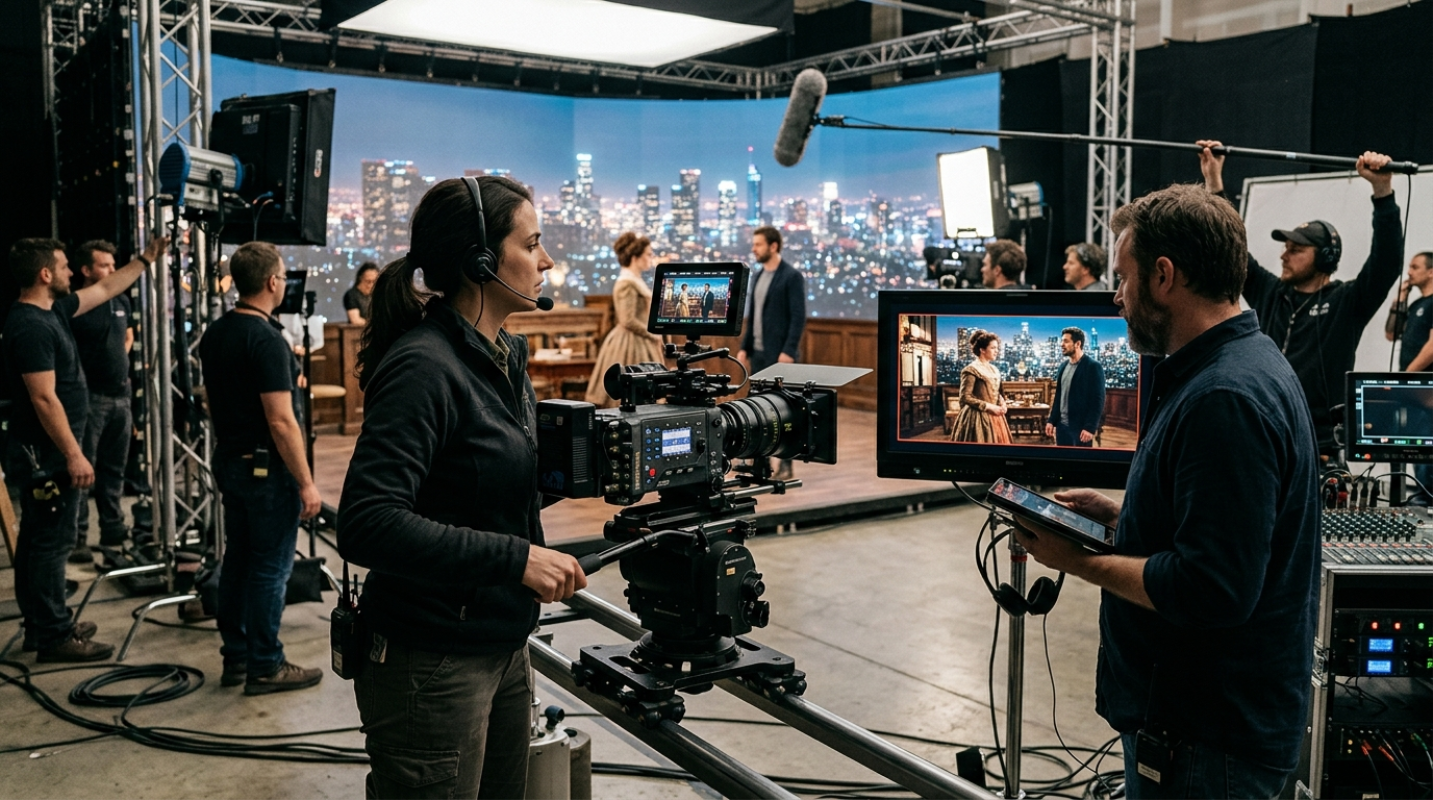
You've probably heard the roar of the debate surrounding AI in Hollywood. It's no longer a "what if" scenario. In 2026, AI is a core part of how movies are built. Although the ethical debates about scriptwriting continue, the real impact is happening in the technical departments. Disney has already replaced about 60% of its physical sets with virtual environments powered by AI tools like SetSimulator Pro.
Think of it like this. Instead of flying a crew of two hundred people to a desert, a studio can now build that desert digitally with a level of realism that's impossible to distinguish from the real thing. Warner Bros even saved $12 million on a single blockbuster by using AI to manage real-time logistics and budgeting. These are the kinds of savings that make studio executives drool, but they come at a human cost.
The job market in Hollywood is feeling the squeeze. In 2025 alone, nearly 55,000 layoffs in the U.S. entertainment sector were directly linked to AI automation.³ We're seeing a world where independent creators can produce high-end content at 20% of what it used to cost, which is great for the little guy but terrifying for the traditional studio system. The big question for you as a viewer is whether a story "engineered" by an algorithm can ever have the soul of something written from human experience.
The Changing Economics of the Big Screen
When was the last time you went to a theater for something that wasn't a massive superhero movie or a giant sequel? The mid-budget movie, the kind of $40 million drama or comedy we used to love, has almost vanished from theaters. Cinema has become about the event. If it doesn't require an IMAX screen or some kind of premium experiential format, most people are choosing to stay home.
The theatrical window, that period where a movie stays only in theaters, has collapsed. It used to be 90 days. Now, it's often as short as 30 to 45 days. NBCUniversal even pushed some movies to home viewing in just 20 days.⁴ This creates a weird dilemma. If you know a movie will be on your TV in three weeks, are you really going to spend fifty dollars on tickets and popcorn?
The studios are fine with this because the math is in their favor. They keep about 80% of the revenue when you rent a movie at home, compared to only 50% of the ticket price at a theater.⁸ This is why we're seeing more "experiential" cinema. Theater owners are trying to turn a movie night into something you can't get on your couch, with better food, immersive seating, and tech like ScreenX that wraps the movie around the walls of the room.
Gaming IP and the Global Shift
If you feel like every new show is based on a video game, you're right. Video games are the new comic books. After the massive success of shows like The Last of Us, every studio is hunting for the next big gaming franchise to adapt. The revenue from game-based movies is expected to double by the end of this year. These stories come with a built-in fan base that's often more loyal than any movie star's following.
At the same time, the "center" of the industry is moving. Hollywood isn't the only player anymore. Because of global streaming, a show made in South Korea or France can become the biggest hit in the world overnight. Studios are moving production hubs to places like London, Seoul, and Toronto to take advantage of lower costs and incredible local talent.
This is great for you as a viewer. You're getting stories from perspectives you might never have seen ten years ago. It's making the cultural exchange faster and more fluid. We're seeing a world where a non-English show isn't a "foreign film" anymore. It's just a hit show that everyone is talking about at the office.